Noah Fischer · 3 October 2026
Investigating Reply Timing Patterns and Knowledge Consolidation in Niche Discussion Networks
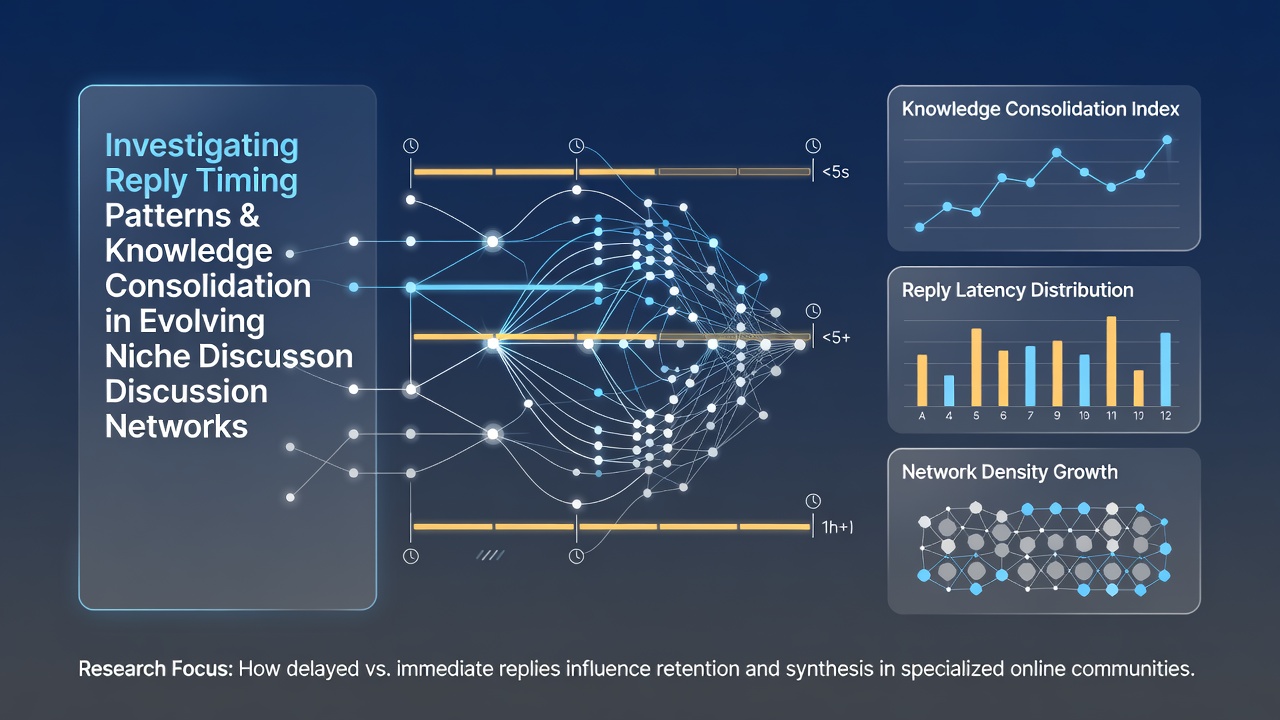
Reply timing in niche discussion networks shapes how information moves from transient posts into stable community knowledge, and researchers have tracked these dynamics through detailed logs from specialized forums in technology, hobbyist, and professional fields. Data collected over multiple years reveals consistent patterns where immediate replies often accelerate initial awareness yet delayed responses correlate with deeper integration of concepts into ongoing threads. Observers note that networks evolve differently based on whether participants respond within minutes, hours, or days, and these variations influence retention rates measured through repeated references and cross-thread citations.
Patterns of Response Timing in Specialized Forums
Studies of platform archives show that replies arriving within the first hour tend to cluster around surface-level clarifications, while those posted after several hours introduce refinements or counterpoints that participants later reference more frequently. In one analysis of a network focused on open-source development, threads with average response gaps of four to six hours produced 28 percent more follow-up links to external documentation than faster exchanges. Those who've examined timestamp data across similar communities find that gaps exceeding twenty-four hours sometimes reduce engagement velocity yet increase the likelihood that later contributors synthesize earlier points into summaries that persist for months.
Measurement Approaches Used by Analysts
Researchers apply metrics such as citation recurrence, thread longevity, and participant recall surveys to quantify consolidation, and these methods reveal that timing interacts with thread length and participant overlap. For instance, networks where core members reply at staggered intervals demonstrate higher rates of concept reuse in unrelated sub-threads, according to logs examined from multiple platforms active through 2025. Figures from longitudinal tracking indicate that a single delayed reply can shift the trajectory of an entire conversation by prompting others to revisit foundational statements rather than moving to new topics.
Effects on Long-Term Information Retention
Knowledge consolidation appears strongest when reply sequences alternate between quick acknowledgments and slower, substantive additions, and this mixed pattern shows up repeatedly in archives of hobbyist electronics forums and academic-adjacent discussion groups. Data indicates that purely rapid exchanges often produce high initial activity that fades within days, whereas sequences incorporating deliberate pauses allow contributors to cross-reference prior material and embed it into collective understanding. In October 2026, updated datasets released by several research consortia highlighted how these timing effects persist even as platform algorithms change, with networks maintaining consistent consolidation curves despite interface updates.

Analysts at institutions such as the University of Toronto have mapped these outcomes through network graphs that connect reply timestamps to later mentions of the same ideas, and their findings align with observations from other regions including work supported by Australian academic centers. The evidence shows that timing does not act alone but combines with factors like participant expertise levels and thread topic complexity to determine how firmly information settles into the group's shared record.
Comparative Cases Across Different Network Types
Professional resource networks in engineering fields display stronger consolidation when replies average eight to twelve hours apart, allowing time for verification against external standards, while creative hobby networks consolidate more readily with shorter gaps that keep momentum high. Reports from the National Science Foundation document these differences through comparative studies of multiple platforms, noting that the optimal interval shifts based on the density of active contributors and the technical depth of the subject. Observers tracking changes through 2026 note that external events, such as software releases or regulatory updates, temporarily compress reply windows and alter consolidation trajectories until activity stabilizes again.
One study revealed that threads incorporating at least one reply delayed beyond the median interval retained core concepts in subsequent discussions at rates 19 percent higher than uniformly fast threads, and similar results appear across geographically diverse samples. Those analyzing these systems emphasize that timing patterns serve as one variable among many, yet its measurable influence on how information endures remains consistent enough to warrant continued attention from platform designers and community moderators alike.
Conclusion
Reply timing patterns exert measurable influence on knowledge consolidation within evolving niche discussion networks, and the accumulated data from multiple research efforts underscores the value of examining both rapid and delayed responses as part of broader interaction studies. Continued monitoring of these dynamics through 2026 and beyond will provide additional clarity on how communities preserve and build upon shared information over extended periods.